

Home Products Personal OS
Personal OS2.0

Your AI waits for you.
It shouldn’t.

Claude now remembers who you are. It still does nothing until you come to it. Personal OS gives Claude and Cursor structure and agents that run on a schedule, including while you sleep.

Get it $97 See how it works $149$97Early Bird

Download, watch the videos, install it yourself in ten minutes. No call required.

Claude Cursor Works with Claude Code or Cursor. Either one is enough.
1:19 · what Personal OS 2.0 is.

Personal OS 2.0 is a ready-made personal system for working with your Cursor or Claude.

It sits on top of what you already use, not another AI. Knowledge, ordered memory, and agents that work for you.

The system runs alongside your Claude or Cursor and knows everything you’re working on: projects, people, tasks, meetings, commitments, and your own rules for how work gets done.

It knows them as connections, not as a list. A project knows which people work on it. A person knows what you promised them. A meeting knows what was decided in it.

Before every task it hands the AI exactly the context that task needs. You say “draft the email to Anna,” and the system already knows who Anna is, what you discussed with her in June, what you promised her, and the tone you usually take with her. You don’t explain any of it again. Ever.

Meanwhile the agents run on their own schedule, without you.

There’s no new app to learn. You stay in the same Claude or Cursor you already use.

Memory is not a system

In 2026 Claude learned to remember: facts about you, your projects, your preferences. It’s genuinely good, and it genuinely works.

But look at what it actually is: a list of topics the AI keeps about you. Here’s where it stops:

  • It remembers you have a project. It doesn’t know the next step or who owns it
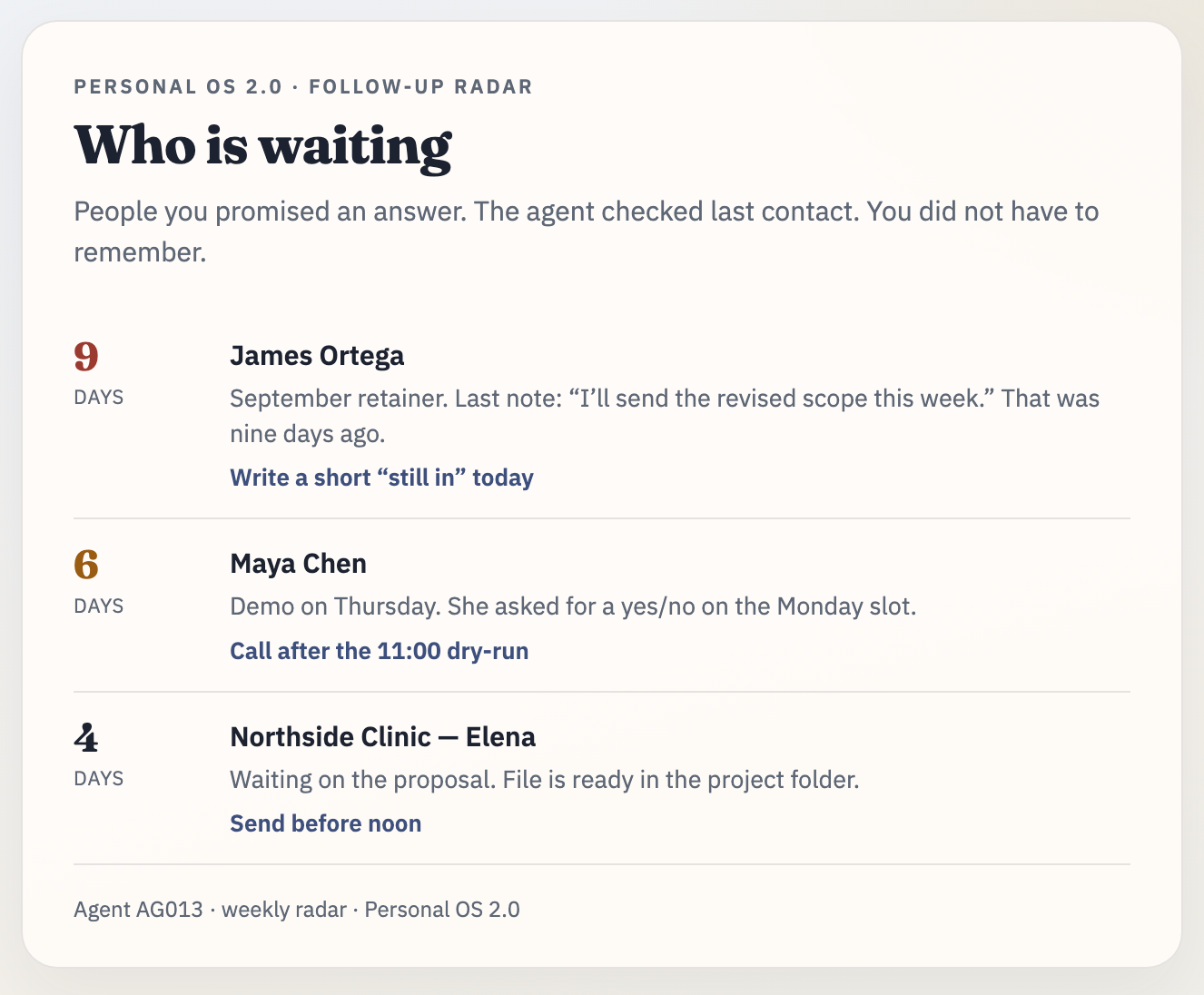
  • It remembers your partner’s name. It won’t tell you that you owed him an answer nine days ago
  • It decides what to keep. You can’t open the store and arrange things the way your work actually runs
  • And most of all: it does nothing until you open a chat. Not in the morning, not on Friday evening, not while you’re away

Anthropic’s own documentation says it plainly: memory does not run scheduled tasks or operate as autonomous agents. That’s not a flaw. It just isn’t what memory is for.

Count up last month: how many times did you re-explain your own projects to an AI? How many rules did you set again from scratch? How many promised replies did you remember yourself, a week late?

Memory answers “who are you.” A system answers “what’s happening and what’s next.”

You wake up and the work
is already done

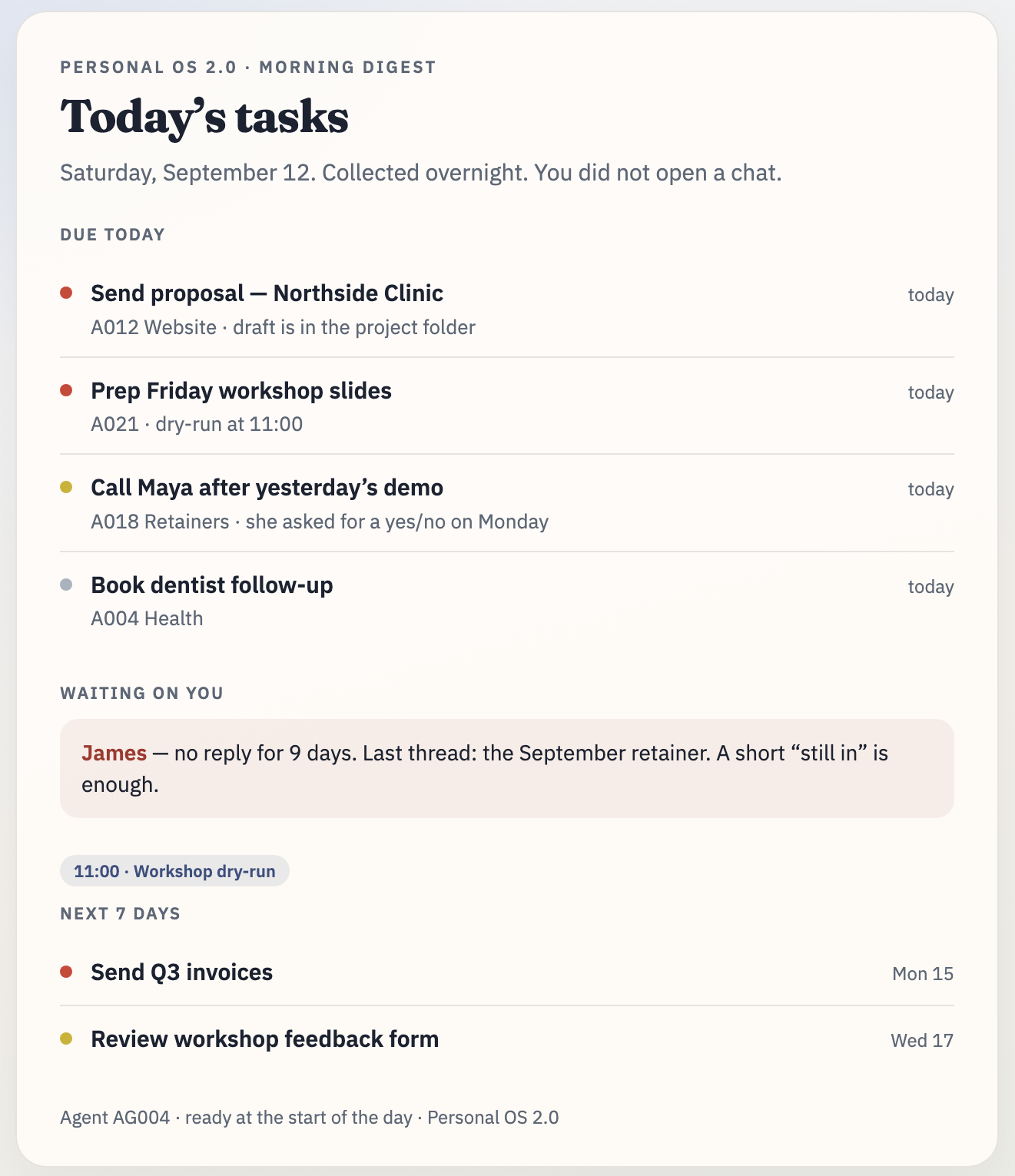
Early morning. You’re still asleep. An agent fires on your machine: collects what changed across your projects in the last 24 hours, checks what’s due today, looks at who you haven’t answered in over a week. By the start of your workday the digest is written and waiting for you.

You didn’t open a chat. You didn’t write a prompt. You weren’t at the computer at all.

Twelve of these come with the system: a morning project review, today’s tasks, a radar for forgotten follow-ups, a weekly review, backups, old-chat harvesting. But twelve is the starting set, not the ceiling. An agent is described in a plain note, and you write as many of your own as you like.

That’s the difference between a tool you go to and staff that work on their own.

See it in the system →

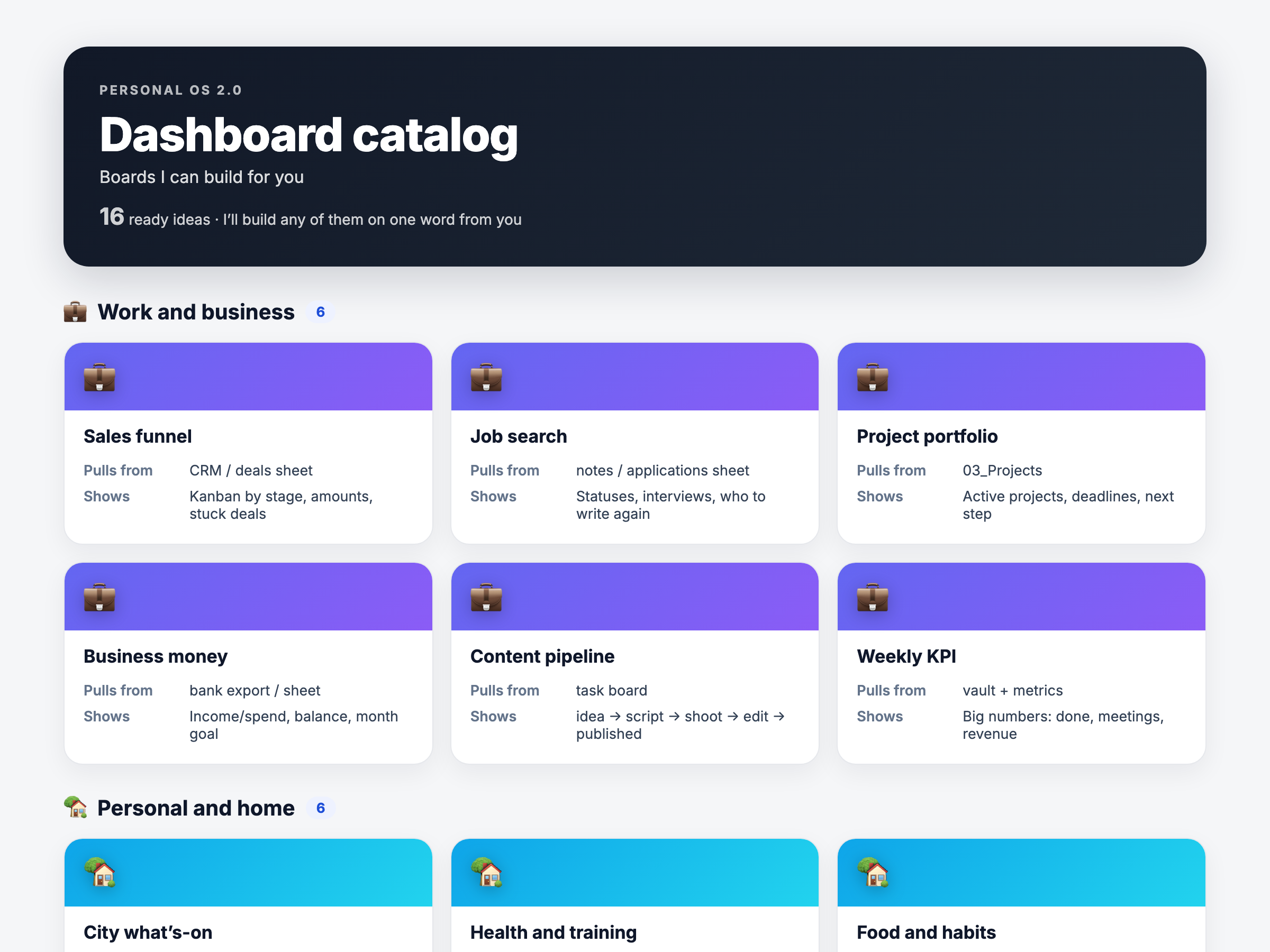
What the running system
looks like

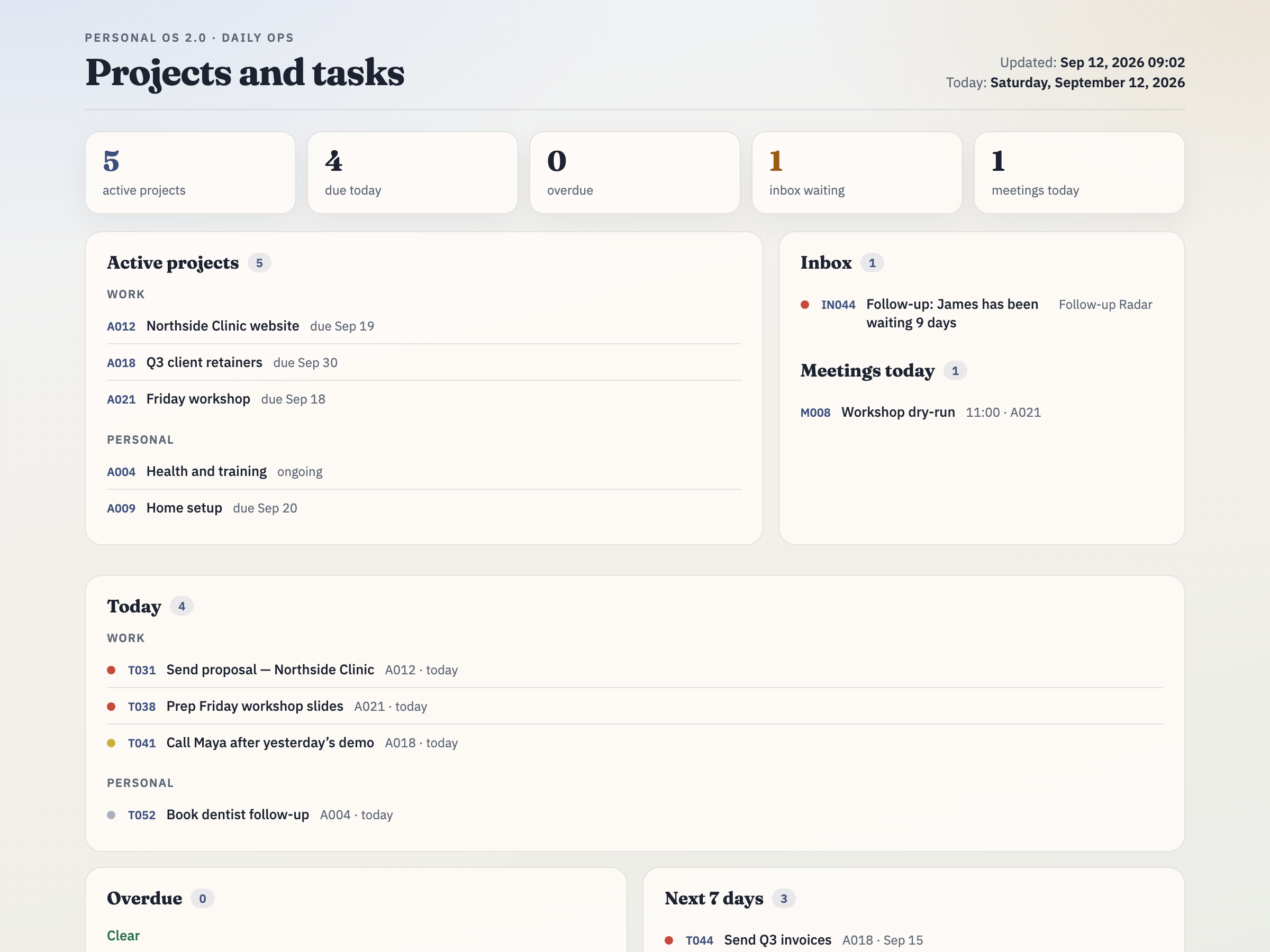
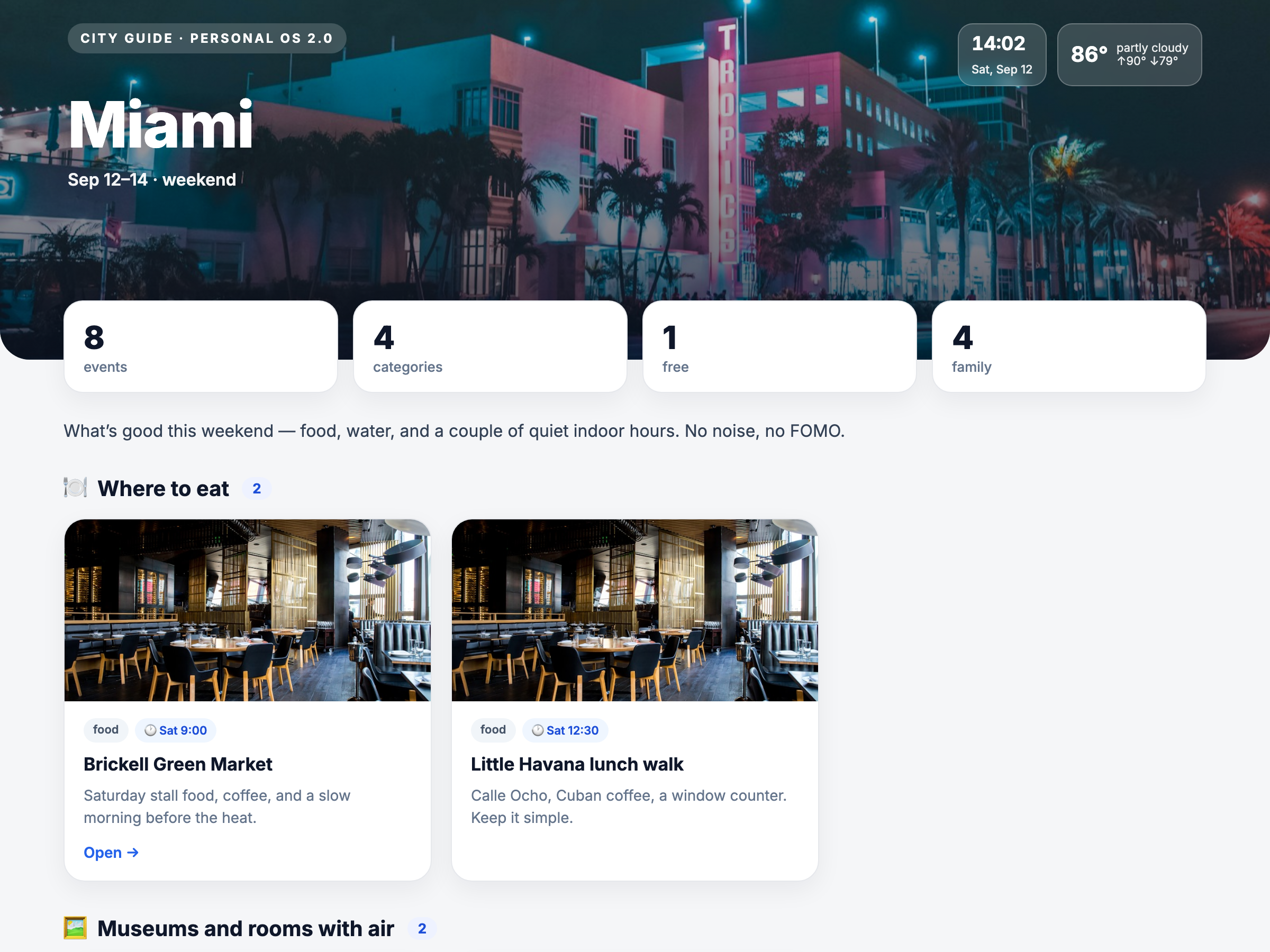
You keep working in the same Claude or Cursor. These are the boards the system builds for you, from our own working setup. Not a demo folder. About us →

Three things on top of
what you already have

/ 01

A structured store

Projects, people, tasks, meetings, ideas, places. Each type has its own template, ID, and links. A project knows which people it touches; a person knows what you promised them; a meeting knows what was decided in it. Not a list of facts, but a graph you can walk.

/ 02

Rules that always apply

How you want things done, in what format, what never to do. They live in a file your AI reads before every task. Not “I asked for that in some earlier chat.” Always.

/ 03

Agents you build yourself

An agent is a plain note: what to do, when to run, what counts as done. Twelve come ready. After that you describe your own, and there’s no limit. That’s what the system is for: not a set of twelve, but a way to hand the machine the things you currently do by hand.

And all of it is yours. Plain files on your own disk: open them, read them, edit them by hand, carry them to another machine.

You’ll put months of your own work into this system. It stays with you if you cancel the subscription, switch models, or the provider changes the rules a year from now.

An honest comparison

We’re not going to pretend Claude’s memory is bad. It’s good. It’s just a different thing.

CapabilityClaude with memoryPersonal OS
Remembers facts about youyesyes
Projects, people and tasks linked to each otherno, it’s a topic listyes, a linked structure
Runs without you, on a schedulenoyes, agents on a schedule
Tells you about a forgotten follow-upnoyes
You can open and edit the whole storepartly, in settingsyes, they’re just files
Where the store liveson Anthropic’s serverson your disk
You decide what enters the contextno, the AI decidesyes
Works in Cursornoyes
Survives cancelling your subscriptionnoyes

These don’t conflict: Claude’s memory keeps working inside the system. It’s just no longer the only thing you have.

To be precise: a local store doesn’t mean the AI runs offline. When Claude or Cursor read one of your notes, that content goes to the provider, exactly like any message you type in a chat. The difference is that the store belongs to you, and you decide what goes into it.

Ten minutes, two double-clicks

Step 1

Download

Right after payment: the archive, the installer, a step-by-step PDF with screenshots, and two short videos.

Step 2

Double-click the installer

It checks your machine, installs what Obsidian needs, and registers the scheduled agents (launchd on Mac, Task Scheduler on Windows). Then it prints a plain-language report: which agents are running and at what time, which are off and why.

Step 3

Type “run the first session”

Open the folder in Claude or Cursor and type that one line. The system walks you through the rest itself.

No call to book, no time to find in your calendar, no waiting on us. If something goes wrong, the PDF has a troubleshooting table, and after that you can email us.

Honest requirements

This is a technical product and you’re installing it yourself. Better to filter you out now than disappoint you after payment.

You need
  • A paid Cursor or Claude subscription. A standard plan (around $20/month) is enough. If you go with Claude it has to be Claude Code, not the browser version
  • Obsidian: free, no account needed
  • Mac or Windows
What not to expect
  • No ready-made email agent. Gmail is connected separately
  • Not a cloud service: the system lives on your machine, so it has to be on for scheduled agents to fire
  • Not a mobile app: the system runs on your computer, and that’s where you work with it

Google connects later, with your own keys, if you want it. A separate guide is included.

Currently available to customers in the United States.

Who this is for

Yes
  • You’re a founder, consultant, freelancer, or operator. You’re in Claude or Cursor every day. You’re running more than three projects and they live in your head, not in a system. You’ve tried to get organised before, in notes, in a task tracker, in prompts, and every time it fell apart within a month, because keeping it in order was manual work.
No
  • You open an AI once a week, you want something with no setup at all, or you’re looking for “an AI that makes money for me.” That’s not this product, and we’d rather say so here than after you pay.

Pricing

Personal OS
Early Bird
$97 $149one payment
  • The whole system: structure, rules, templates, twelve ready-made agents
  • The installer for Mac and Windows: two double-clicks, ten minutes
  • A step-by-step PDF with screenshots and a troubleshooting table
  • Two short videos: what it is, and how to set it up
  • Instructions for connecting Google, if you want it later
  • Email support

Launch price. After Early Bird it’s $149.

Rolled out to your company
from $5,000

We install the system across your team in a shared Zoom session: everyone follows along on their own machine, questions answered as they come up. One hour to install, one hour to configure and run a first real task.

Team sizePriceSessions
up to 5 people$5,000two × 60 minutes
up to 10 people$9,000four × 60 minutes
up to 25 people$18,000agents for your processes included

Every rollout includes: the system for each person, your existing projects and contacts migrated in, and 30 days of support for the whole team.

We take no more than two rollouts a month. Larger than 25? Write to us and we’ll price it.

Talk about a rollout

One payment, no subscription. Personal licence, one person.

Prices in USD. A one-time charge: no subscription, no recurring billing, nothing to cancel. Sales are currently limited to customers in the United States, and payment is accepted on US-issued cards only. Payment is processed by Stripe; we never see your card details. The archive, installer, PDF guide and videos are delivered by email immediately after payment. Because the files are delivered at once, the sale is final; if the system doesn’t run on your machine, write to [email protected] and we will work through it with you until it does. Personal licence, one person; the LICENSE file is included in the archive. By buying you agree to our Terms of Service and Privacy Policy. Sold by AI4Live LLC, 7901 4th St N STE 300, St. Petersburg, FL 33702 · [email protected].

You won’t be left alone
with this

The installer prints a report at the end: what worked and what didn’t. If something didn’t come up, send us that report. We’ll work through it with you until the system is running.

I want it working on your machine. Someone whose system never started won’t leave a review and won’t tell a friend about it, so I answer these myself and I don’t drop them halfway.

[email protected]

Questions

Memory answers “who are you,” and it does that well. It doesn’t build links between projects, people and tasks, it doesn’t give you direct access to the store, and it doesn’t run anything on a schedule. That last point isn’t our opinion. It’s Anthropic’s own wording: memory does not “run scheduled tasks or operate as autonomous agents.” Personal OS adds exactly that, and Claude’s memory keeps working alongside it.

The installer does the work for you: it checks your machine, sets up what’s needed, registers the schedules, and tells you in plain language what worked and what didn’t. The PDF has a troubleshooting table for the handful of things that can go wrong. If you’re still stuck, write to [email protected]. We’ll stay on it until it runs.

A template is folders and notes. It waits for you to put something in it. This adds a rules layer your AI reads and twelve agents that fire on their own schedule. A template sits still. This system works while you sleep.

Both work. We build on Cursor, for three reasons.

Limits

In Claude you can hit a ceiling mid-task and wait hours. Cursor has separate limits per model: switch to another one and keep going.

Model choice

Cursor connects anything over API: Anthropic, OpenAI, Chinese models, your own local one. You’re not locked to a single provider.

Privacy Mode

Cursor holds zero-data-retention agreements with all providers: your content isn’t used for training and isn’t stored. One honest caveat: this isn’t offline. Requests still pass through Cursor’s infrastructure, which they document themselves.

If you already live in Claude and you’re happy there, go with Claude, the system works the same.

Either one works, but it has to be desktop Claude Code, since claude.ai in a browser can’t open a folder of your files.

To us: nothing. To Anthropic or Cursor: whatever the AI reads while doing a task, exactly as in a normal chat, no more. The difference from memory is that there the AI decides what to keep on their servers, while here the store is yours and you fill it. If you have data that should never reach a model, keep it outside the system.

The system stays with you and works with another model. These are ordinary files, not tied to an account, a subscription, or one provider. The scheduled agents are ordinary scripts on your own machine.

They will change; Claude’s memory is the proof. If something breaks for everyone, we fix it and send the fix to owners.

Yes. The system finds them on your machine and asks what to keep.

No. One payment.

The system, the installer, the guide and two videos. One payment, no subscription. If it doesn’t run, write to support and we’ll fix it.

Your AI already remembers.
Now give it work

Get it $97

Launch price. After Early Bird it’s $149.